


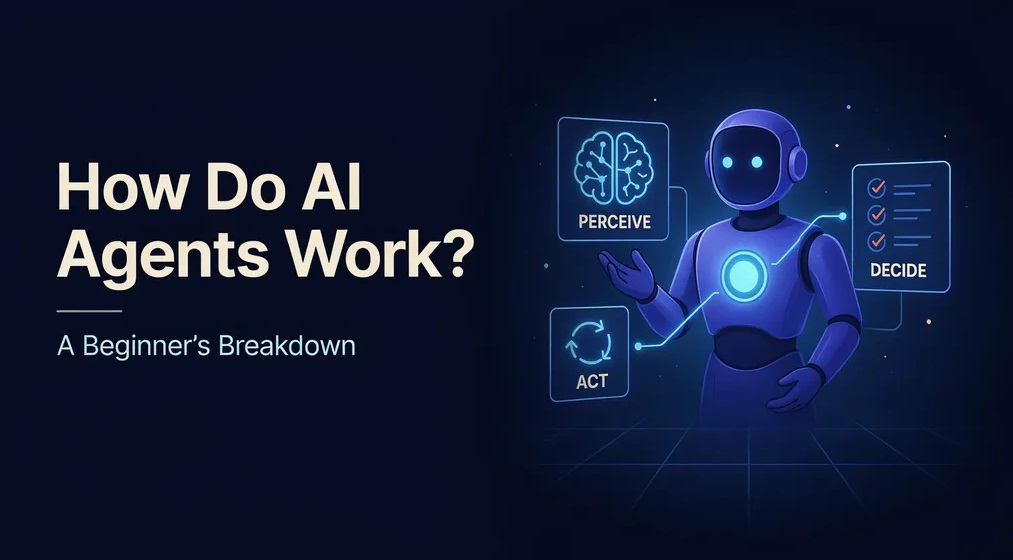
If you’ve read our [What Is Agentic AI? Start Here] guide, you already know the short version of how AI agents work: they look, decide, act, and check. That’s enough to follow a conversation about AI agents. But if you’re curious what’s actually happening in those four steps — without needing a computer science degree to follow along — this is the deeper, still-jargon-free breakdown.
The Building Blocks Inside Every AI Agent
Strip away the branding and every AI agent, from a trip-planning tool to a customer-service bot, is built from the same handful of parts working together.
- The senses (input). This is how the agent receives information your typed instructions, a webpage it reads, data from a calendar or app it’s connected to.
- The brain (reasoning). Usually a large language model, the same underlying technology behind tools like ChatGPT or Claude. This is what interprets your goal and figures out a plan.
- The hands (tools and actions). The agent’s connections to the outside world — the ability to search the web, fill out a form, send an email, or call another piece of software.
- The memory. A running record of what’s happened so far in the task, so the agent doesn’t lose track partway through a multi-step job.
None of these parts is exotic on its own. What makes something an “agent” is that all four work together in a loop, without you manually triggering each step.
The Different Types of AI Agents
Not every agent is built the same way, and knowing the rough categories makes the label less mysterious.
- Simple rule-based agents. These follow fixed if-this-then-that logic with no real “thinking” involved. A thermostat that switches on below a set temperature is technically an agent, just a very basic one.
- Goal-based agents. These are given an objective — “find me a flight under £200” — and work out their own steps to get there, adjusting if the first approach doesn’t work. Most of what people mean by “AI agent” in 2026 falls into this category.
- Learning agents. These improve their own behavior over time based on feedback, like a recommendation system that gets better at predicting what you’ll want next the more you use it.
Many real-world tools blend these categories rather than fitting neatly into one box.
What’s Actually Happening When an Agent “Decides” Something
It’s tempting to picture an agent “thinking” the way a person does, but it’s worth being precise here: an AI agent isn’t reasoning from understanding or intent the way a human would. It’s predicting the most useful next step based on patterns learned from enormous amounts of text and data, combined with the specific instructions and information it has right now. The result can look remarkably like judgment — because for many everyday tasks, statistically likely and genuinely useful end up being the same thing. But it’s prediction, not comprehension, and that distinction matters when you’re deciding how much to trust an agent with.
When Multiple Agents Work Together
Some tasks are too complex for one agent to handle well alone, so a growing number of tools split the work across several specialized agents instead — one that researches, one that writes, one that checks the output for errors — coordinating with each other the way a small team would divide up a project. You won’t usually see this happening; from the outside, a multi-agent system just looks like one tool that happens to be unusually thorough. But it’s worth knowing the term “multi-agent system” if you come across it, since it’s becoming common in more advanced tools.
A Walkthrough: The Lisbon Trip, Step by Step
Going back to the example from our beginner’s guide — “plan me a weekend trip to Lisbon under £400” — here’s what’s actually happening behind the scenes:
- Input: The agent reads your instruction and pulls out the key details — destination, budget, that it’s a weekend trip.
- Planning: It breaks this into sub-tasks: find flights, find a hotel, check they fit the budget together, build a rough schedule.
- Tool use: It searches flight and hotel data through connected services, not by “knowing” prices from memory.
- Checking: If the first flight and hotel combination goes over £400, it doesn’t just report failure — it tries a different combination automatically.
- Output: It hands you a finished plan, having made dozens of small decisions along the way that you never had to see or approve individually.
That’s the same loop from our beginner’s guide, just with the machinery underneath made visible.
A Word on Hype: Not Everything Called “Agentic AI” Actually Is
Worth knowing before you evaluate any tool marketed this way: analysts at Gartner have estimated that only a small fraction of products branded “agentic AI” roughly a hundred or so out of thousands making the claim — actually meet the bar of dynamically directing their own tool use, rather than following a fixed script dressed up in agent language. A simple test if you’re ever unsure: if a tool can’t decide mid-task to try a different approach than the one it started with, it’s a scripted workflow wearing an agent label, not a true agent.