


Agentic AI is the shift from an AI that answers your questions to one that actually does the work for you. Here’s the old way: you open five browser tabs, compare flight prices, check a hotel booking site, cross-reference reviews, and build your own itinerary by hand. Here’s the new way, with agentic AI: you tell an AI agent “plan me a weekend trip to Lisbon under £400,” and it checks flights, compares hotels, builds the itinerary, and hands you a finished plan — no tab-switching required.
That shift, from you doing every step yourself to an AI doing the steps for you, is what this guide is about.
What Agentic AI Actually Means
Agentic AI is a type of artificial intelligence that can take action toward a goal, not just answer a question about it. Think of the difference between a helpful assistant sitting at a desk who answers whatever you ask, and one who can also get up, check the filing cabinet, send the email, and follow up next week without being reminded. The first is reactive. The second has agency — it can plan, use tools, and carry a task through multiple steps on its own.
An “AI agent” is the actual system doing this — the software built to carry out a role, like booking, researching, or scheduling. “Agentic AI” describes the behavior — a system that plans, decides, and acts with limited human input. You’ll often see the two terms used almost interchangeably in casual conversation, and that’s fine for everyday purposes.
Agentic AI vs. a Regular Chatbot
The easiest way to tell them apart is to look at what happens after you ask for something.
| Regular chatbot | AI agent | |
|---|---|---|
| What it does | Answers your question | Completes your task |
| How many steps | Usually one reply | Multiple steps, in sequence |
| Uses outside tools | Rarely | Yes — search, calendars, bookings, apps |
| Remembers context mid-task | Limited | Tracks progress across the whole task |
| Example | “Here are three flight options” | Actually finds, compares, and books the flight |
If you ask a chatbot for restaurant recommendations, it gives you a list. If you ask an AI agent to book a table, it checks availability, picks a time that fits your calendar, and confirms the reservation — then tells you it’s done.
How an AI Agent Actually Works (No Tech Jargon)
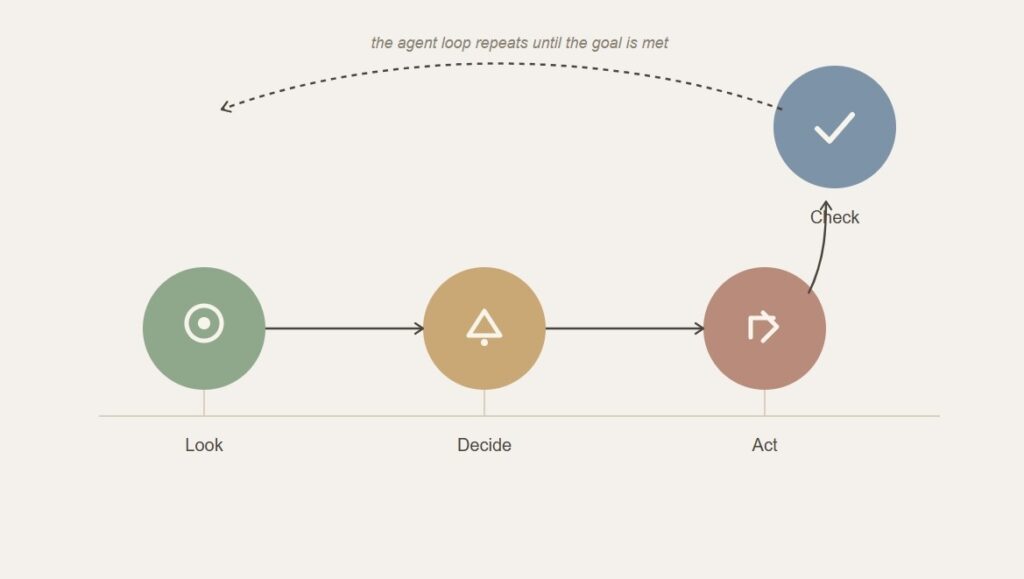
Strip away the engineering terms, and every AI agent is really just repeating a simple four-step loop:
- It looks at the situation. This might mean reading your instructions, checking a calendar, or scanning a webpage.
- It decides what to do next. Based on your goal, it works out the next useful step — not the whole plan at once, just the next move.
- It takes action. This could be searching the web, filling out a form, sending a message, or updating a file.
- It checks the result and adjusts. If the first attempt doesn’t work — a flight sells out, a form field is missing — it tries a different approach instead of just giving up.
That loop repeats until the goal is met or it needs your input. It’s less like a single smart reply and more like handing off a small errand.
Is Agentic AI the Same as Generative AI?
No, but they’re closely related. Generative AI is what creates things text, images, code based on a prompt. Agentic AI is what acts on things, often using a generative AI model as its “brain” for reasoning, but adding the ability to plan, use tools, and carry out multi-step tasks. In practice, most AI agents you’ll encounter in 2026 are built on top of generative AI models the generation part writes and reasons, the agentic part plans and does.
Common Questions Beginners Ask
Do I need to know how to code to use one?
No. Most consumer-facing AI agents the kind built into apps you already use, or no-code tools designed for beginners — need plain-language instructions, not code.
Is it safe to let an AI agent take action on my behalf?
Reputable tools build in checkpoints, asking for your confirmation before anything sensitive like a payment or a sent email. Always check what permissions you’re granting before connecting an agent to accounts that matter — more on this in our safety guide below.
What’s a simple, real example?
Google Maps rerouting you around traffic without being asked is a small, everyday example of agentic behavior: it senses a change, decides on a better route, and acts on it automatically.
Will this replace the apps I already use?
Not exactly agentic AI is increasingly built into the apps you already have, rather than replacing them outright. The shift is happening inside familiar tools, not around them.